Javidence™ - a precise, evidence‑led path to the right number.
Javidence™ connects discovery, dependency and licence intelligence with specialist Oracle Java licensing expertise. You retain full control of your environment throughout.
Discovery & Inventory
Javidence™ discovers Java evidence across approved filesystems and enterprise environments, then classifies each finding by the relevant licensing context.
ELP Analysis
We build an evidence‑supported Effective Licence Position — classifying licensable and bundled Java, modelling relevant metrics, and exposing the gap between Oracle’s ask and the planning position supported by your evidence.
Negotiation Support
An optional Consultancy Service.
With a clear, evidence-based picture in hand, we support you through your conversations with Oracle — so you can approach them with confidence, clarity and verified facts on your side.
Your team runs it. Your data stays home.
Because the scan needs access to your servers and endpoints, your team executes it directly — so your security and data‑privacy policies are fully respected. We guide you at every step.
No permanently installed Right‑Sizing endpoint agent. Customer‑hosted and air‑gap capable, with no mandatory vendor‑cloud upload.
Automated scanning across your entire fleet at once — every host at its own pace.
No permanent endpoint agent is required. Avoid the time, complexity and disruption of installing and maintaining agents across thousands, or even tens of thousands, of endpoints.
On‑premise, cloud, VDI, endpoints and containers — including restricted and intermittently connected environments.
Every binary classified across all five Oracle Java licence types — BCL, OTN, NFTC, RUL and BLRA — so it’s clear what’s free, what’s licensable, and what’s bundled.
One specialist Java view across the modern enterprise.
Different operating environments need different collection and evidence paths. Javidence™ normalises them into one consistent analysis without publishing the proprietary mechanics behind the platform.
Servers & endpoints
Physical and virtual servers, cloud, VDI, desktops and laptops—including devices that may be temporarily offline.
Restricted networks (air-gapped)
Customer‑controlled options for government, defence, banking, critical infrastructure and other highly governed environments.
Three evidence pathways
Running containers, selected registry images and supported third‑party SBOM or software‑inventory evidence.
Application & runtime context
Connect Java installations with the applications, runtimes and packaged components that may rely on them.
Multiple commercial models
Universal Subscription, Processor and Named User Plus analysis using evidence appropriate to each scenario.
Validated optimisation
Prioritise action, retain rationale, validate change and maintain traceability from executive summary to technical evidence.
Your entire Java estate, made clear.
The scan resolves into a single interactive licensing dashboard — a 360‑degree view of your estate. Java version, licence status, host details, installation path, install date, etc; every dimension captured, classified and laid out in full. Below is a real example of what you receive — an executive view of where you stand, down to the version‑by‑version detail behind it.
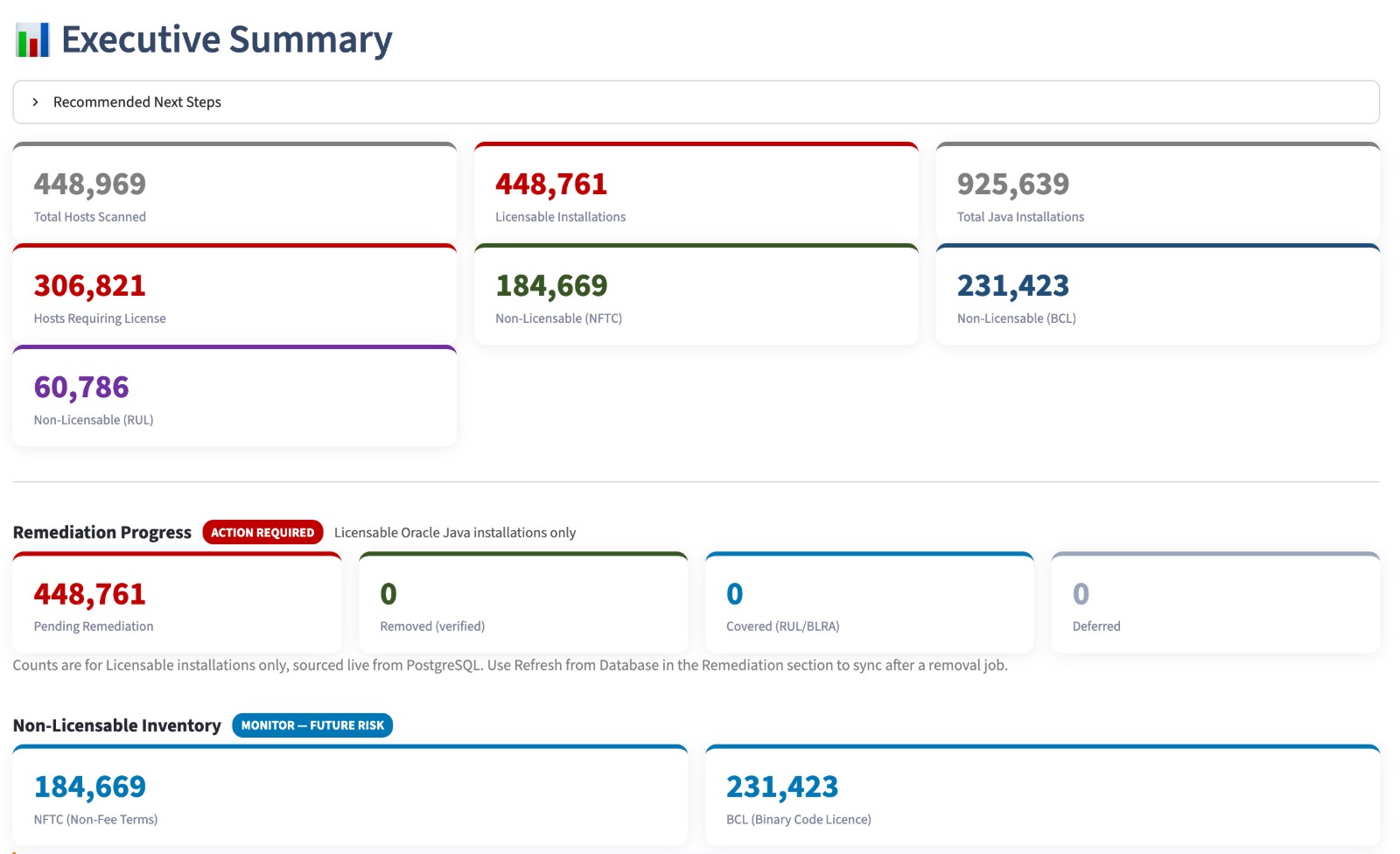
The whole estate at a glance — total hosts scanned, total installations and exactly how many are licensable versus free, with a clear remediation status alongside.
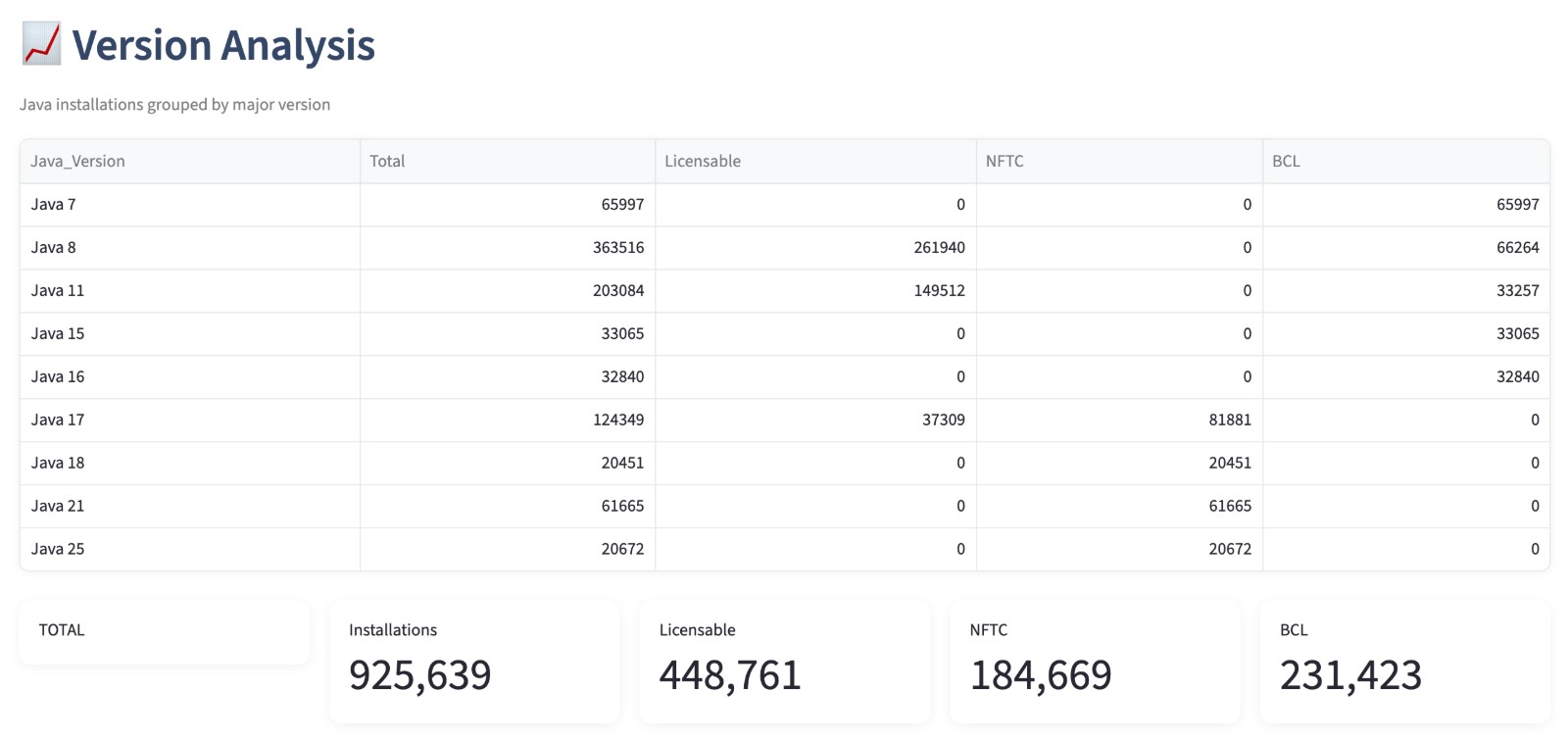
Installations grouped by major Java version — with the licensable, NFTC and BCL split made explicit for every release, so the source of your exposure is never a mystery.
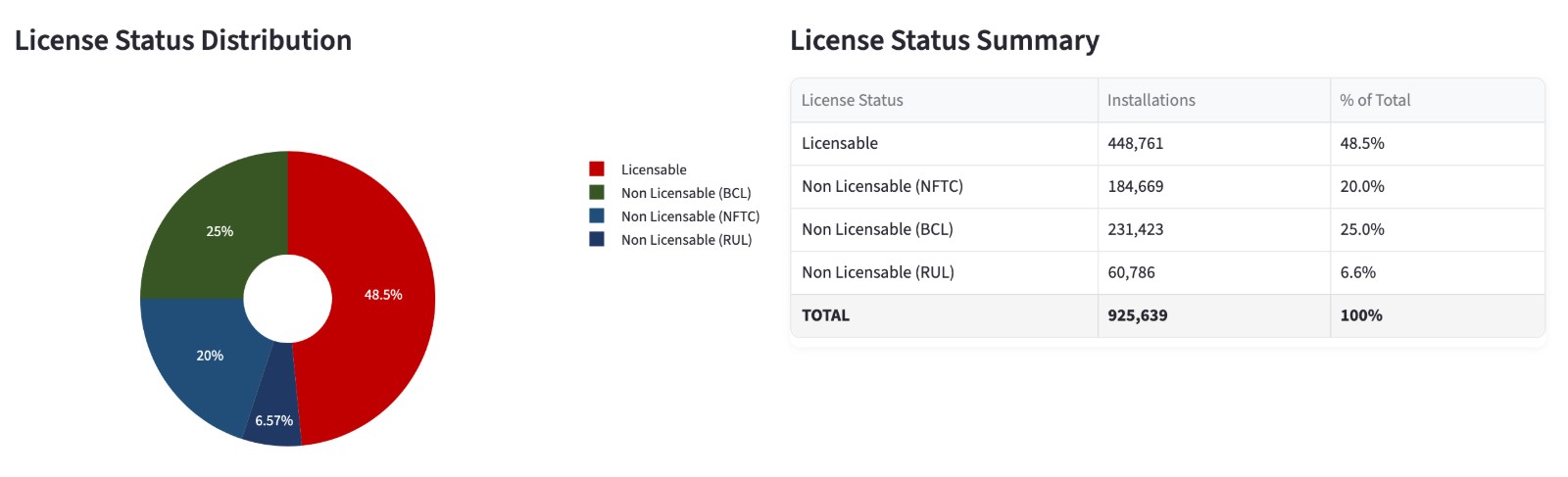
A single, unambiguous breakdown of what is licensable versus free across the entire estate — the picture that anchors every conversation that follows.
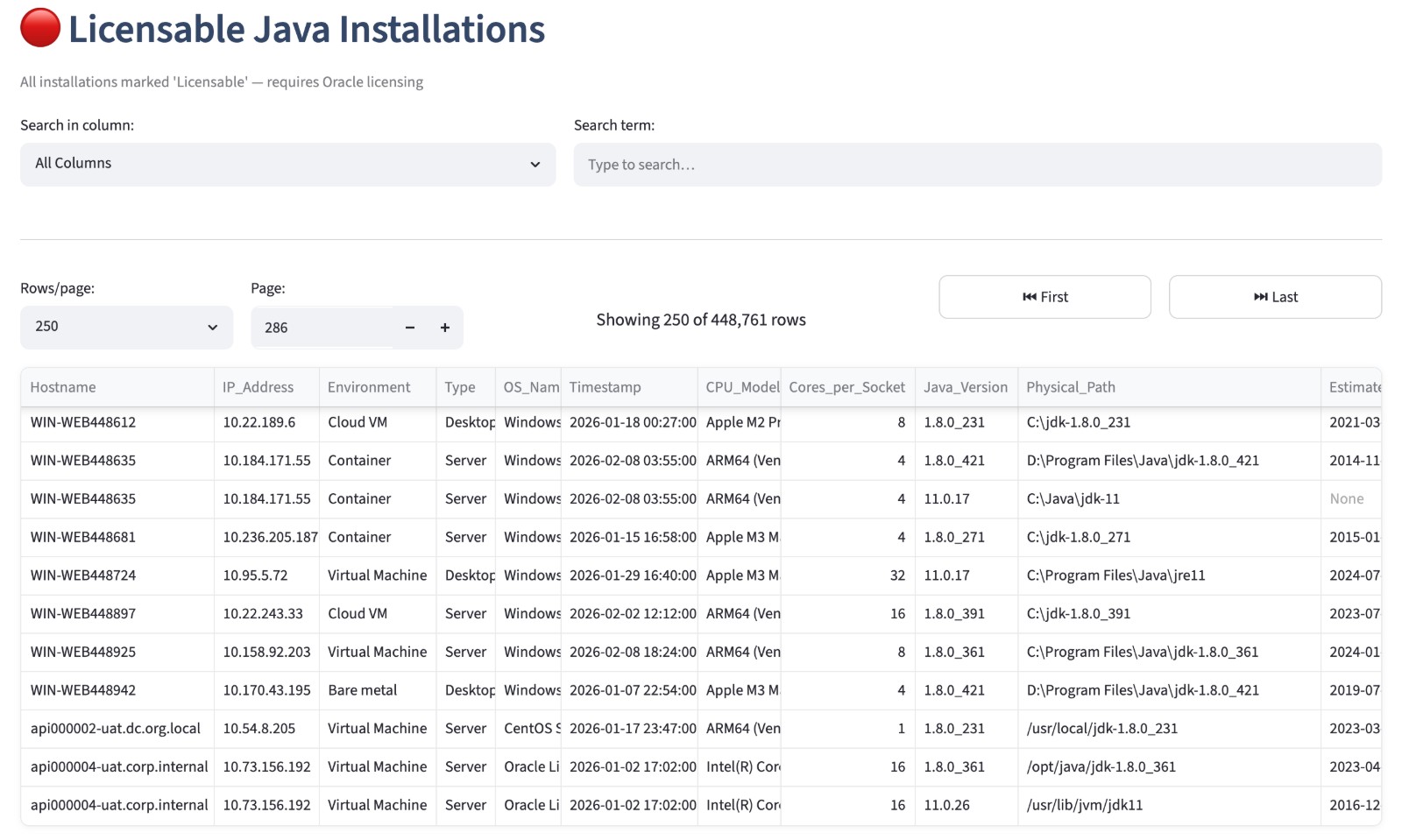
Down to the individual install — host, environment, processor, Java version and exact path — searchable across hundreds of thousands of rows. The evidence behind every headline figure.
More than a dashboard — a complete evidence pack.
Everything on screen is exportable to a polished, presentation‑ready executive report and to raw data your own team can review and verify. The figures are sourced live, never estimated — so every number is one you can stand behind.
KPI summary, licence-status donut and recommended next steps in one screen.
Per-host and per-installation detail, searchable and fully exportable.
Breakdown by Java version, OS family and virtual‑vs‑bare‑metal footprint.
A polished, branded report generated on demand — charts, tables and narrative.
Renewing, or starting fresh? We right‑size both.
We work fluently in both, whether you’re facing Oracle for the first time or renewing a long‑standing agreement.
Universal Subscription
Oracle’s current model counts your entire headcount — every full‑time, part‑time, temporary and contract employee.
We prove how many employees are genuinely in scope — so you’re measured on reality.
Legacy Subscription
Processor licence is for servers (cores × Oracle’s core factor) and Named User Plus for client users.
We verify your processor, core factor and NUP counts accurately, so you only pay for what you currently use.
The renewal decision matters. Moving from legacy Processor & NUP licensing to Universal Subscription can help or hurt, depending on your headcount and footprint. We model both paths with verified data so the choice is an informed one — never a default.
A clear division of responsibility.
The three steps above describe what happens. This is who does it — so the boundary between your team and ours is clear before we begin.
A note on scope. Migrating away from Oracle Java to OpenJDK is not part of our engagement — but where it makes sense for you, we’ll happily refer you to a suitable, independent vendor.
See where you stand — with evidence.
Start with a confidential conversation about your Oracle Java environment and exposure.
Talk to us →